


Nasdaq A-D Line “Divergence”
Free Chart In Focus email
Delivered to you every week
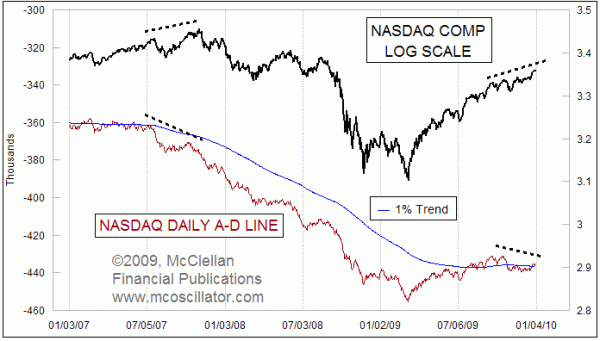
As major stock market indices have risen to higher highs, some analysts are starting to worry about a supposed non-confirmation from the Nasdaq A-D Line. That A-D Line made a high on Oct. 14, 2009, but has not gone back up yet to equal that high in spite of the Nasdaq Composite Index exceeding its own Oct. 14 level by over 4%.
What this means is that a minority of the issues traded on the Nasdaq have been responsible for the push to higher price highs, while the majority have not kept up. The presumption is that such a condition is problematic, and the divergence shows a loss of upward momentum.
That would certainly be the correct interpretation if we were seeing a divergence like this on the NYSE A-D Line. Despite all of the (unfounded) criticisms of it for its supposed contamination because of "interest sensitive issues", the NYSE A-D Line is still the best indicator of market liquidity I know of. The Nasdaq A-D Line, on the other hand, has a long track record of having a terribly negative bias, so much so that divergences like this one should not be trusted.
Taking a longer look at the Nasdaq A-D Line, we see that it has been in a really big downtrend for a long time. The whole technology boom of the 1980s and 1990s was great for the Nasdaq Comp, but not enough to lift the majority of Nasdaq stocks.
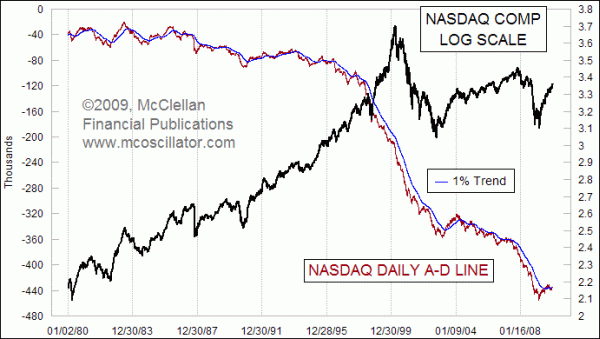
Part of the reason for this is that the listing requirements for the Nasdaq are different than for the NYSE. Generally speaking, it is harder to get listed on the NYSE. This accounts for a big portion of the downward bias in the Nasdaq A-D Line. If a company is going to go public, and then go broke, it is more likely to do that on the Nasdaq. Every day it spends going from its IPO price down to zero contributes one down issue for the Nasdaq breadth tabulations.
Here is a trivia question for you to use to stump your friends: When was the last time that the Nasdaq A-D Line made a new all-time high? The answer is: Never. It has never made a new all time high. Our data (.xls file) on Nasdaq A-D numbers date back to December 1972, which is when Barron's first began publishing them. Decliners outnumbered advancers right off the bat, and the A-D Line has never made it back up to the zero point.
Nasdaq breadth statistics can still be very useful to a technician, when viewed and analyzed properly. Looking at the upward or downward acceleration is very useful, which is why the McClellan Oscillator and Summation Index can be helpful. But one should not make the mistake of seeing a divergence between the A-D Line and prices, and believing it is always a sign of trouble. There are too many false alarms in its history for such an assumption to have merit.
Tom McClellan
Editor, The McClellan Market Report
Nov 20, 2009 NDX A-D Oscillator |
Oct 16, 2009 A-D Line Has the Story on Corporate Profits |
Oct 30, 2009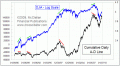 A-D Line Back Near All-Time Highs |