


Predicting The Future of Gasoline Prices
Free Chart In Focus email
Delivered to you every week
Almost all of us are affected in some way by the movements of gasoline prices. So this week I want to share with you a really cool insight about how to predict 2 months ahead of time where gasoline prices are likely to go. It does not work perfectly; it merely works extremely well.
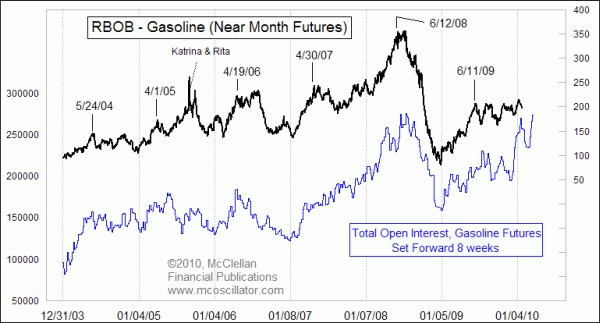
The chart this week compares gasoline futures prices to the total open interest in all gasoline futures contracts. The open interest plot is set forward by 8 weeks to reveal the leading indication that it gives for where gasoline prices are likely to go.
The abbreviation "RBOB" stands for "reformulated blendstock for oxygenate blending", which is an absolutely horrible name. Clearly, the marketing folks were not involved in that naming decision. RBOB refers to a new standard formulation, established in 2007, which replaced the old standard for unleaded gasoline. The new standard was required because of the phase out of an additive chemical, MTBE. The open interest data used in this chart comes from the CFTC's weekly Commitment of Traders (COT) Report, and includes older gasoline futures contracts to construct this historical plot.
I do not know precisely why the open interest data provides such an accurate leading indication for where prices are going to go. Clearly, most of the players in the gasoline futures market are not aware of this phenomenon, otherwise they would have taken advantage of it by now. And now that I am telling you all about it, it is a reasonable presumption that it won't work as well going forward, since the word is out now.
I also cannot explain why this leading relationship did not work prior to around January 2000 (not shown in this chart). I just observe that it is working now quite well, even if I don't have a good explanation for why it should work. And we should not blame this leading indicator for not knowing how much of a price spike would occur during the 2005 hurricane season.
One other point worthy of note in this chart is that gasoline prices show a very strong seasonal tendency to see a top sometime between April and June. Producers and refiners ramp up for the summer driving season, and prices climb in advance of the actual increase in gasoline consumption over the summer. We should fully expect to see such a top between April and June this year as well.
Looking at the leading indication right now, it tells us to expect to see a drop in RBOB futures prices over the next 3-4 weeks, and then a rebound back to the recent highs or even higher. How much of that dip will trickle through to prices at the pump is a bit more complex of an issue. But if you are looking ahead to when to fill up the gas tank on your yacht, or when to expect the stocks of oil refiners to bounce, a leading indication like this can be quite useful. It is one of the charts we feature fairly frequently in our Daily Edition.
Tom McClellan
Editor, The McClellan Market Report
Sep 04, 2009 Unemployment Rate Rising On Schedule |
Nov 06, 2009 Civilian Employment Level (Follow Up) |
Aug 14, 2009 Gas Versus Oil: Who’s Right? |