


Stock Market Matching The Year Ago Pattern
Free Chart In Focus email
Delivered to you every week
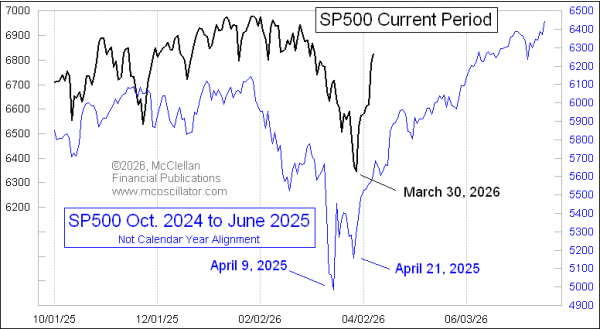
Several analysts I respect have noted that the price structure in 2026 is looking a lot like that of 2025. This week's chart highlights that point, but I had to do a little bit of tweaking to get the best pattern fit.
Whenever I employ price pattern analogs, I strive to find the best overall fit of even the minor price wiggles. That helps to validate (or not) that I have a good pattern comparison. To get the best fit in comparing 2026 to 2025, I had to do a little bit of time shifting, so that there is not a perfect calendar alignment. Doing this better aligns the lesser movements in the left hand of the chart. The plots are shifted 15 trading days apart from a strict calendar alignment in order to get the better pattern match.
To help illustrate this point, here is the same chart with the two plots arrayed with a strict calendar year alignment in the chart:
We can still see a general similarity of the chart structures, but not as tight of a match of the smaller dance steps.
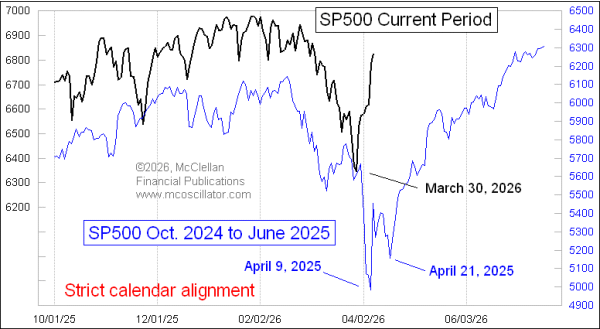
I prefer to use a comparison with the best alignment of structures that I can get, even if that goes against strictly following calendar seasonality. The presumption of analyzing any chart structure is that price structures are a manifestation of the unfolding of human emotions as they get applied to price movements. Similar emotional scenarios result in similar price structures, or so goes the theory. There is no perfect way to test that hypothesis.
Anyone employing chart pattern analogs should also be aware that all of them will eventually break correlation. In my experience, the moment when they break correlation is usually the moment when one is counting on the relationship most to continue working. So I never give them my full confidence because of that inherent fickleness.
Turning our attention back to the top chart, if the current year's pattern continues to match that of 2025, then we can expect a nice uptrend lasting through the summer of 2026. One problem with that expectation is that the stock market typically moves sideways to lower from May to October, and especially in the second year of a presidential term. So we will have to see which factor is stronger, i.e. the feeling of relief after the Iran War cease fire matching the relief after the April 2025 tariff crash, or the normal seasonal tendencies. For the moment, the market is still matching the 2025 time-shifted pattern, and we are still in the bullish phase of normal annual seasonality. The conflict does not arrive until May gets here.
Tom McClellan
Editor, The McClellan Market Report
Jan 09, 2026
Seasonality and the January Dip |
Mar 13, 2025
Deviation From The Presidential Cycle Patterns |
Feb 14, 2025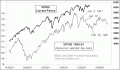
Closing the Book on 1981 Analog |