


Seasonality and the January Dip
Free Chart In Focus email
Delivered to you every week
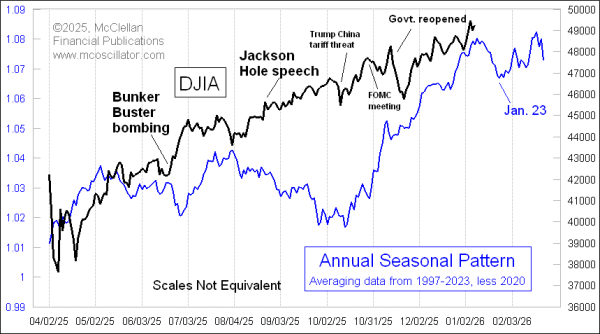
We are still in the "best 6 months of the year", due to last until early May 2026, and so the current uptrend ought to continue. But we should also expect a meaningful dip this month, based on the DJIA's Annual Seasonal Pattern (ASP) shown in this week's chart.
I created this ASP by chopping up the daily data into 1-year chunks, restating their value for each year to a starting value of 1.00, then averaging them together as the percentage change from that starting value rather than the numerical value of the index. Doing that revaluation allows for more accurate averaging than using the raw numerical values, because with raw values the later years with higher index numbers would have a bigger weight. It puts each year on an equal footing.
I also leave out the entire year of 2020, because the Covid Crash was such an abnormal event and a very large one, such that it skews the data. The point of creating such an average is to depict what "normal" looks like, and the market's response to the Covid shutdowns and then the Fed's monstrous QE was definitely abnormal. Throwing it out is like discarding the highest and lowest judges' scores in platform diving or figure skating competitions.
One big factor affecting the use of the ASP this year is that there have been several big news events which have pushed the stock market around in ways not reflected in the ASP. We have not had one of those events for a while, and the market is behaving itself pretty well in tracking the ASP. But that could change at any moment. One might argue that the stock market was a lot more sensitive to news events early in President Trump's current term, but stock traders are getting more accustomed to tumultuous news out of Washington DC, and thus they are less reactive to it now.
The month of January typically sees a mid-month dip, with a top ideally due Jan. 10, and then a bottom ideally due Jan. 23. After that bottom, the market on average gets back to trending higher. And it could get a boost from the QE5 which the Fed has now restarted, although they are not calling it that yet. Since the last FOMC meeting, the Fed's Treasury holdings are up by $46 billion. They are still rolling off mortgage backed securities (MBS), but the net effect of both factors is still a $32 billion rise in the Fed's balance sheet. That is a bullish tailwind for the stock market.
Whether that QE can paper over the normal seasonal tendency for a January dip is what remains to be seen.
The Annual Seasonal Pattern is one of the indicators I feature regularly in our twice monthly McClellan Market Report and our Daily Edition. https://www.mcoscillator.com/market_reports/
Tom McClellan
Editor, The McClellan Market Report
Aug 22, 2024
Annual Seasonal Pattern’s Late Summer Dip |
Jan 04, 2024
Seasonality Shows A January Dip |
Nov 18, 2021
Exploring the Mysteries of Seasonality |