


Hindenburg Omen Fires 5 Signals
Free Chart In Focus email
Delivered to you every week
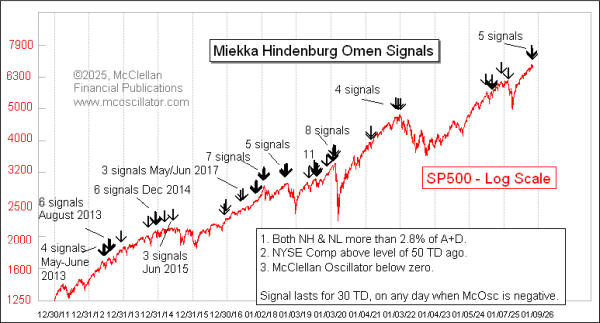
There was some excitement in the world of technical analysis the past two weeks as we saw 5 separate signals fire for something called the Hindenburg Omen. This is a warning signal of trouble, but trouble does not always come. What is fair to say is that Hindenburg Omen signals have appeared at every major stock market top going back several decades. But they have also appeared at other times.
The creator of this signal was the late James Miekka, who died tragically in 2014. Miekka was a blind mathematician and stock market analyst who had a great way to see numbers in his head, even though he could no longer see them with his eyes. His father helped him with publication of his newsletter, The Sudbury Bull and Bear Report.
Miekka created this signal as an attempt to improve on the late Gerald Appel's "Split Market Sell Signal", which triggered on any day that the NYSE saw more than 45 New Highs (NH) and New Lows (NL) on the same day. That signal was developed when there were fewer issues traded, and so the first adjustment was to allow for more issues, and not use a fixed number. Miekka also wanted to add additional filtering criteria, insisting for example that the market be in an uptrend. He figured there was no use for a warning signal when you are already in a downtrend.
Over the years, Miekka tinkered with the criteria, and that has created some confusion in the world of technical analysis. The criteria for the signal listed in the chart above are those which Miekka told to Greg Morris for his 2006 book, The Complete Guide To Market Breadth Indicators.
The name for the Hindenburg Omen came from the late Kennedy Gammage, who wrote The Richland Report newsletter and who was a big fan of using the McClellan Oscillator. Ken was a frequent guest on FNN, which was a cable business news predecessor before CNBC. Miekka introduced this signal to Ken, who had a background in marketing and knew that it needed a catchy name. Ken knew of a signal created by Bill Ohama called the Titanic Syndrome, which happens when NL exceeds NH within 7 trading days of a new 1-year high in the SP500, so he proposed the Hindenburg Omen which Miekka adopted.
Generally speaking, Hindenburg Omen signals tend to matter more when you see a big cluster of them in a short space of time. Here is one way of looking at that, using a 6-month lookback.
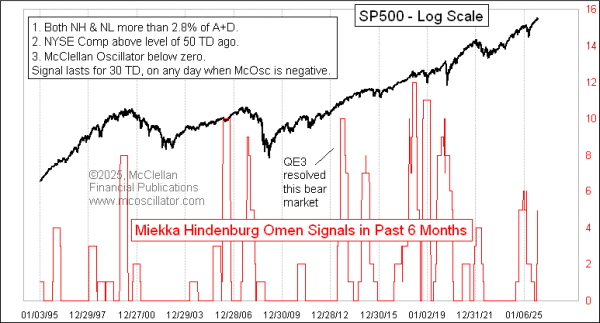
The current count of 5 signals is not as big as some other clusters. But we got 4 signals in a cluster at the end of 2021, ahead of the 2022 bear market. So 4 is enough, if the market is inclined to live up to this warning. And 2 signals were enough back in December 2024 and March 2025 to tell us about the trouble in the market which unfolded in the April 2025 tariff reaction minicrash. But 5 is better.
Calamity does not always happen, especially in cases like 2013 when the Fed was doing QE3 and throwing a lot of money at the banking system. Fed QE can paper over lots of ordinary types of problems. And if we get QE5 in the next few weeks as some are speculating, that lesson from 2013 would be an important one to remember to help put these recent Hindenburg Omen signals into context.
Some analysts are dismissive of the Hindenburg Omen because of how there have been several instances of failed signals. Miekka acknowledged that in the rules he crafted, something which these dismissive analysts fail to take into account. He insisted that the signal was only valid for the next 30 trading days, and only on days when the McClellan Oscillator is below zero. If the McClellan Oscillator goes above zero during that 30 trading day forward look, the signal remains valid but not in effect as long as the Oscillator is positive. You can see the McClellan Oscillator value every day on our web site's Market Breadth Data page, https://www.mcoscillator.com/market_breadth_data/.
These recent signals should not be viewed as a guarantee of trouble. They are like your check engine light, which could mean you are out of engine oil (really bad!!), or it could just be a loose gas cap. Use this information in concert with other indicators of trend direction, and as a warning that something is going a little bit unusually in the market, which may be worth keeping in mind.
Tom McClellan
Editor, The McClellan Market Report
Sep 28, 2018
Ten Hindenburgs So Far |
Dec 11, 2014
What Hindenburg Omens and an Oil Crash Mean |
Jun 06, 2013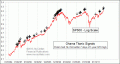
Hindenburg and Titanic, OH MY! |