


QE is Bearish For T-Bonds
Free Chart In Focus email
Delivered to you every week
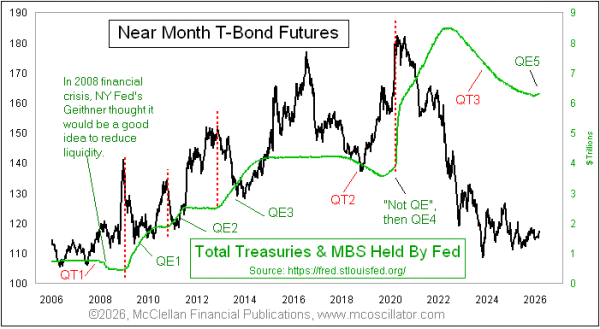
The Federal Reserve is now doing QE5, although we are not supposed to officially call it that yet. All four previous rounds of quantitative easing (QE) have been unquestionably bullish for the stock market. But the same cannot be said for T-Bond prices.
During all 4 previous QE episodes, T-Bond prices have seen a dramatic drop, which also means a rise for long term yields. So if QE5 is going to unfold in the same way, then we can look forward to higher long term yields on T-Bonds, and presumably also on home mortgages and other long term debt.
One factor which is different this time is that bond prices have not just seen a big rally leading up to the start of QE5. All four previous episodes saw QE starting as bond prices were at a spike top. So there was a lot of room each prior time for bond prices to give back the big gains they had just made. This time there has only been a small rise in T-Bond prices.
Why would QE be bad for bonds? This does not make intuitive sense. After all, if the Fed is going to step in as a new incremental buyer of Treasury debt, then that additional demand should mean upward pressure on prices, and yet we see it works the opposite way.
Part of the answer is that the Fed's purchases of Treasury debt during prior rounds of QE have tended to be in shorter maturity instruments, T-Bills and T-Notes. So they are not adding very much direct additional buying pressure at the long end of the yield curve.
QE also acts as an economic stimulus, which in theory drives up demand for longer term credit from businesses looking to finance expansion. That puts upward pressure on longer term rates.
That is all great in theory, but what is still unknown is if it can work this same way for a 5th time without having the big run up first in bond prices.
Tom McClellan
Editor, The McClellan Market Report
Sep 18, 2020
Is QE Good For Gold Prices? |
Jun 09, 2016
ECB QE Doing Opposite of Objective |
Oct 25, 2024
Reverse Repos Mitigate Fed’s QT |