


Investors Intelligence Sentiment Extreme
Free Chart In Focus email
Delivered to you every week
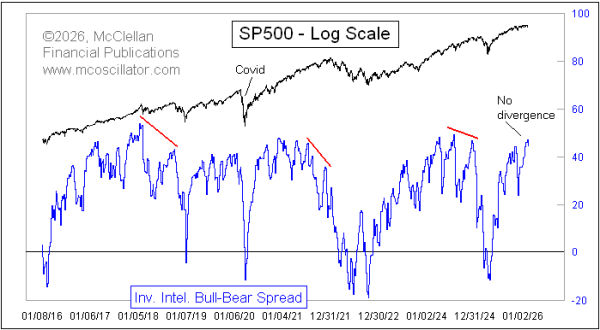
Recent data from the Investors Intelligence weekly survey of investment advisors and newsletter writers showed a very high bull-bear spread. That spread is simply the numerical difference between the percentage of respondents classified as bullish versus those who are bearish. High readings show extreme confidence, which every card-carrying contrarian knows is a sign of a top for stock prices.
But before you go placing any sell orders just based on this one indication, a few caveats are important to keep in mind. The first is that any overbought reading on any indicator constitutes just a "condition, not a signal". Sometimes an overbought condition can go on to get even more overbought. It is also worth noting that in many cases, the stock market has been able to continue trending higher in spite of such a reading, especially in a strong bull market.
That point is worth pausing to reflect upon. If the stock market can ignore an overbought condition and keep trending higher, that is a sign you are in a strong trend. And that is really useful information to find out. Very low readings are much more reliable in terms of marking focused bottoming events.
A more concrete indication that we are seeing right now is the lack of a divergence versus prices. This week's chart looks back 10 years, and there have been a few really noteworthy price tops over that period, plus a whole lot of lesser tops which did not matter much. The really big price tops saw a divergent lower top on this bull-bear spread versus prices. The one big exception to that "rule" was in 2020, when Covid took everyone by surprise. So to see no divergence now means that we can have pretty high confidence that the market now is NOT at a really important top. It may still be making a lesser top, but not a major one.
One point about these data from Investors Intelligence is that they seem to track with prices more precisely than other sentiment survey data that I have researched. I noticed this point years ago, and sought a way to track that even better. What I came up with was using a detrended plot of the SP500 instead of the raw price data. To do that, I calculated how far the SP500 was away from its 200-day simple moving average. This chart shows that comparison:
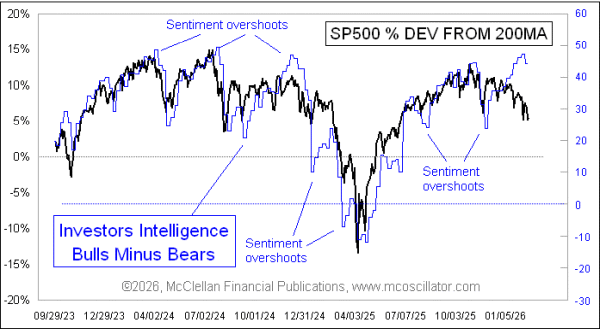
This chart uses a shorter lookback period, and compares that same bull-bear spread to that detrended plot of the SP500. With a little bit of scaling adjustment, we see that the two plots are almost identical most of the time. In other words, sentiment responds to whatever prices are doing. A rising market gets people more bullish, and vice versa. Occasionally, though, we see a big disagreement when the bull-bear spread seems to overshoot what prices have been doing. In other words, survey respondents are getting more fearful or more confident than prices say that they should have done. That usually marks a turning point for prices.
In the current moment, that turning point has taken the form of having the SP500 lagging behind what other parts of the market are doing, causing the detrended price plot to fall. Sentiment should soon catch up (i.e. down) to what prices have been doing.
One last point to notice in that lower chart is that the zero levels on the two Y-axes are offset. This was done in order to get the best fit of the two plots, and it reveals something. There is about a 15 percentage point bullish bias in the Investors Intelligence survey data versus how prices behave. I would argue that this bullish bias is appropriate, because in the long run the stock market does tend to go up. It is just interesting to quantify what that bias amounts to in these data.
Tom McClellan
Editor, The McClellan Market Report
Apr 02, 2025
Investors Intelligence “Correction” Percentage |
May 13, 2022
Investors Intelligence Data at Bearish Extreme |
Jul 22, 2021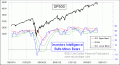
Big Weekly Drop In Investors Intelligence Data |