


Hindenburgs Are Back
Free Chart In Focus email
Delivered to you every week
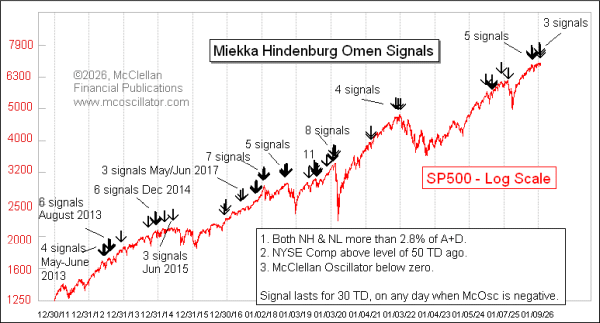
The NYSE's daily A-D Line just made a new all-time high on Feb. 4, 2026, which is a statement that liquidity is plentiful. But just a day later, we have gotten the 3rd Hindenburg Omen within 6 trading days. This is a message that for all of that supposedly plentiful liquidity, the market has some serious problems.
The late Jim Miekka created the Hindenburg Omen signal back in 1995. He intended it as an improvement on the late Gerald Appel's "Split Market Sell Signal", which occurred any day that saw both New Highs and New Lows on the NYSE exceed 45 issues. Miekka saw the problem of not adjusting that for the increased number of issues traded. And he wanted to add some other filtering rules to get better signals. An important one is that the market has to be in an uptrend to give a signal. Miekka thought it was not very useful to get such a warning once stock prices are already in a downtrend. The criteria for a Hindenburg Omen signal are listed in the chart above.
If you do an Internet search, you will likely find other sets of criteria at some technical analysis web sites, which is unfortunate. And because Miekka has passed away, we cannot get him to correct the record, so that task is left to others. The criteria I use are those which Miekka personally told to Greg Morris, who recorded them in his 2006 book, "The Complete Guide To Market Breadth Indicators".
The basic idea for the Hindenburg Omen signal is that during a normal uptrend, there should be more stocks making New Highs than making New Lows. That is the normal condition. If you get a condition where the uptrend is still underway, but the numbers of New Lows start perking up, then that is a sign of trouble. What constitutes "perking up"? That's a matter for opinion, and perhaps back-testing, but Miekka set his threshold at both NH and NL being greater than 2.8% of Advances plus Declines on the same day. Other analysts might choose a different criterion, which people are perfectly allowed to do. But for the sake of consistency, and so as to avoid confusion, I stick with Miekka's criteria.
A single signal is interesting, but the message gets more compelling when we see clusters of multiple signals in a short time frame. We had a grouping of 5 signals from Oct. 29 to Nov. 13, 2025, but the market shrugged. Now we have 3 more (so far) and would have had a 4th on Feb. 4, 2026 except that the NYSE's McClellan A-D Oscillator was just barely positive that day.
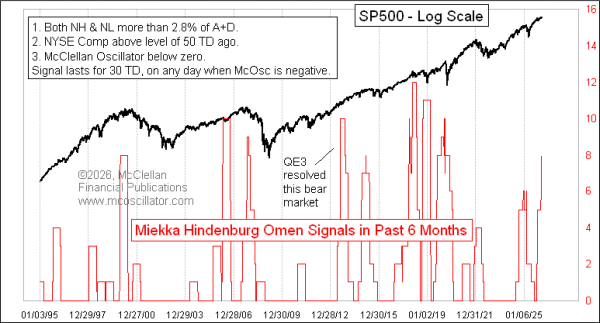
I have found that using a 6-month lookback period to count cumulative Hindenburg Omen signals is useful. On that basis, we are now up to 8 signals, which is a pretty high reading. Some noteworthy market tops have come from big readings like this. But we must also note that there have been other times when we got a bunch of H.O. signals and nothing much happened. That is possible. A Hindenburg Omen signal, or a bunch of them, is a warning but not a guarantee of trouble. It says "pay extra attention".
The last such cluster appeared at the end of 2024, right after the presidential election. It did not tell us exactly what trouble was brewing, but it did appear just ahead of the stock market's violent drop on tariff worries courtesy of President Trump. A lesser cluster appeared in early 2022, ahead of that year's bear market.
It is noteworthy that there was a cluster of 10 signals in 2013, and the uptrend just powered on through. It is important to remember that the Fed back then was doing QE3, and QE can paper over lots of problems. The Fed now is doing yet another round, QE5, although not as vigorously as some past QE episodes. So it is possible that the Fed will paper over the trouble again this time.
Tom McClellan
Editor, The McClellan Market Report
Nov 13, 2025
Hindenburg Omen Fires 5 Signals |
Dec 11, 2014
What Hindenburg Omens and an Oil Crash Mean |
Jun 06, 2013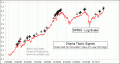
Hindenburg and Titanic, OH MY! |