


Reverse Repos: A Dead Issue (Or Are They?)
Free Chart In Focus email
Delivered to you every week
I wrote here back in September 2025 about how the total amount of Reverse Repurchase (RRP) agreements at the Federal Reserve was bottoming out, and how they were thus ceasing to be an issue for the stock market. That thesis needs a review, given the past few days' data.
To review, a regular Overnight Repurchase Agreement (or Overnight Repo for short) is a transaction between the Fed and a member bank in which the Fed effectively lends money to a bank. The process involves the sale of Treasury debt with an agreement to repurchase it later at a defined price, set to match the Fed Funds target rate.
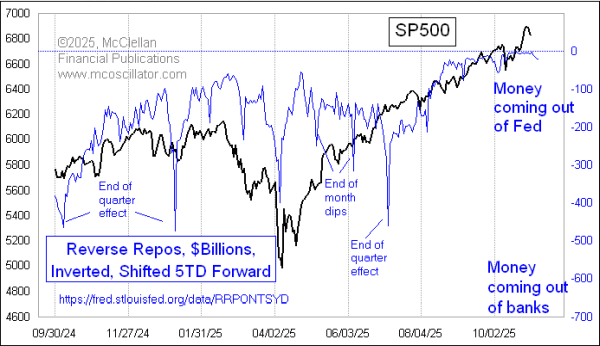
A Reverse Repo or RRP is the same transaction but done in the opposite direction. In a RRP, the Fed effectively borrows money from a bank, which has the effect of reducing liquidity in the banking system. That matters to the stock market because changes in RRPs tend to have an effect on stock prices about 5 trading days (TD) later, as illustrated in this week's chart. In that chart, I have inverted the scaling on the total amount of RRPs just to help us see the relationship with a positive correlation.
When RRPs increase (blue plot going down in the chart), that takes away liquidity, and the stock market tends to suffer. That effect helps to explain why we had a bear market in 2022 (not shown), because the Fed was trying to undo the effects of QE4 and so it ramped up RRPs to a high of $2.5 trillion.
As they have been unwinding that, and shrinking the total size of their RRPs, liquidity effectively comes back out of the Fed and into the banking system, thereby making it available to do things like help lift stock prices. But with RRPs down to almost zero, there is no fuel left in that tank and so the stock market is going to have to find liquidity (or not) in other places.
That should have a net neutral effect on stock prices, except that for some reason RRPs are starting to rise again (blue inverted chart plot going down) over the past few days. RRPs got down to just $2.4 billion on Oct. 24, but now they are back up again to $19.2 billion. That is not a whole lot of money in the scale of Fed operations, but it has a negative effect on liquidity.
Overnight Repos and RRPs are not the same thing as Quantitative Easing (QE) or Quantitative Tightening (QT), which is where the Fed buys or sells Treasuries on the open market. But repos are like QE because the Fed is renting Treasuries, either in or out, and thus having the same type of effect on liquidity.
Now, as RRPs have been getting down close to zero, the Fed is suddenly becoming more active doing Overnight Repos. The sizes are still small, but they are not nothing.
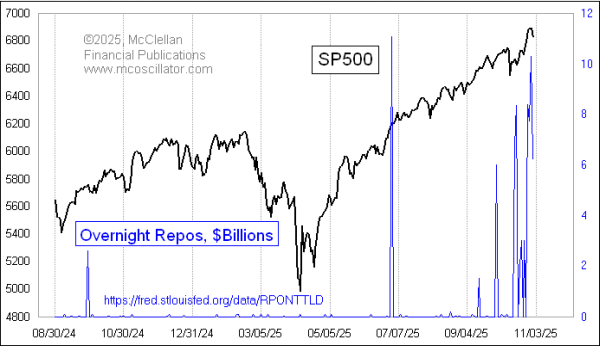
On Oct. 29, the Fed did $10.3 billion in Overnight Repos, and this comes as part of an awakening of that activity since the Fed started cutting rates again in September. Many times these Overnight Repos are done as part of an effort to get the overnight trading of deposits among member banks to match the FOMC's target rate. Doing an Overnight Repo adds liquidity, but it also conveys a statement that there seems to be a need for liquidity in the banking system. That jump up to $10.3 billion of Overnight Repos on Oct. 29 matched a jump higher for the SP500 to a top that day. And then as Overnight Repos backed off to just $6.2 billion on Oct. 30, we saw the SP500 pull back.
I don't have any inside information on what the Fed is going to do next with its repos activity. But I do know that their activity in RRPs tends to work with about a 5TD lag, and that should mean a dip for stock prices, assuming things work as they have been.
You can track data yourself on RRPs and Overnight Repos at these links:
https://fred.stlouisfed.org/data/RRPONTSYD
https://fred.stlouisfed.org/data/RPONTTLD
Tom McClellan
Editor, The McClellan Market Report
Sep 25, 2025
Reverse Repos Bottoming Out |
Jul 17, 2025
Revisiting Reverse Repos |
Aug 21, 2025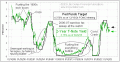
What the Fed Should Do, and What Lumber Says About That |