


Reverse Repos Bottoming Out
Free Chart In Focus email
Delivered to you every week
Back in 2021, the Fed turned to what had previously been an almost-never used tool, the Reverse Repurchase Agreement (RRP). This is a variation on the longstanding tool known as a Repurchase Agreement. In a RRP, the Fed "sells" some of its Treasury debt to a bank, with an agreement to buy it back later for an agreed upon price. As collateral for the transaction, the bank pledges some of its more conventional loan book assets. Such a transaction therefore ties up those bank assets, making the bank less capable of loaning out "money" to people and companies.
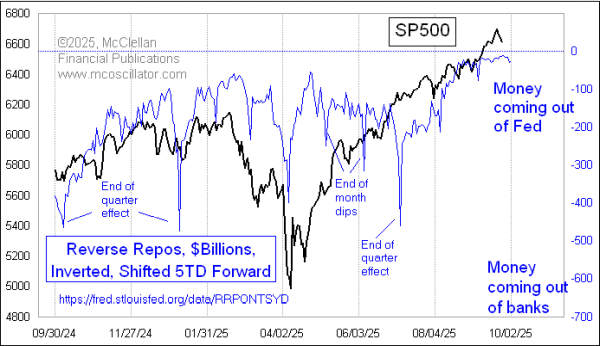
The important point to understand is that existence of an RRP acts as a drain on financial market liquidity. And thus the unwinding of an RRP makes more liquidity available. That is why the plot is inverted in the chart, because less RRPs means a higher stock market. A bank engages in one of these transactions because having Treasuries on the bank's balance sheet makes the bank's overall asset picture look better.
The total size of RRPs with the NY Fed reached an astonishing $2.5 trillion at the end of December 2022. Now it is down to just $25 billion. Part of the fuel for the big bull market since 2022 has been this unwinding of RRPs, which acted effectively as a form of Quantitative Easing (QE), even though it was technically a different form of liquidity injection.
This week's chart is one that I have shared here before, comparing an inverted plot of RRPs to the SP500. There is one additional adjustment which is important, that the inverted plot of RRPs is shifted forward by five trading days to show that there is a slight lag in how the changes get to work on moving stock prices.
The important point to note right now is that since RRPs are almost down to zero (up to zero on the inverted plot), the bull market fuel from this source is about at empty. So if the bull market is going to continue, then it is going to need to find one or more other source of fuel.
One possibility, if the Fed wants to do this, is that the Fed could go back to doing conventional Repurchase Agreements, which is a way of having the Fed effectively lend money to banks to help increase liquidity. The Fed used to do this a lot during the 2000s, but got away from it for the most part in 2008 during the Great Financial Crisis. That exit from doing Repos was poorly timed, and it arguably amplified the problems which the stock market and the economy faced.
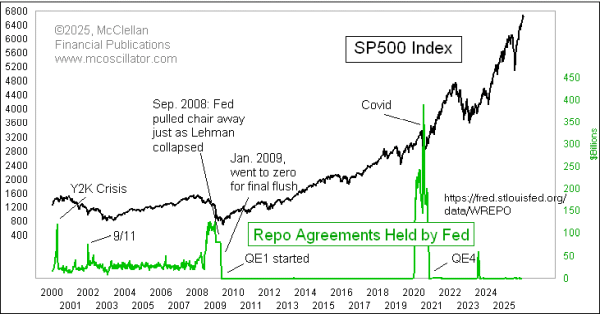
The Fed returned to doing Repos again starting in late 2019, at a time when the FOMC foresaw liquidity problems coming. You may remember that the Fed also restarted doing outright purchases of Treasuries and Mortgage Backed Securities (MBS) then, which Chairman Powell admonished us was "Not QE". The Fed upped those actions even more in early 2020 during the Covid Crash, but then unwound those Repos by July 2020 when they decided that it was enough for the Fed to do $1 trillion per month of regular QE.
Regular Repos have been quiet lately, but if you hear that the Fed is starting them up again, you can know that the honchos at the Fed are seeing problems coming and want to throw more liquidity at those problems. Until then, the stock market is going to have to just get by without artificial support from Fed actions. And now we get to see how well, and for how long, the stock market can get by on its own.
Tom McClellan
Editor, The McClellan Market Report
Feb 06, 2025
Reverse Repos Waning |
Jul 17, 2025
Revisiting Reverse Repos |
Aug 21, 2025
What the Fed Should Do, and What Lumber Says About That |