


Summation Index Crosses Neutral Level
Free Chart In Focus email
Delivered to you every week
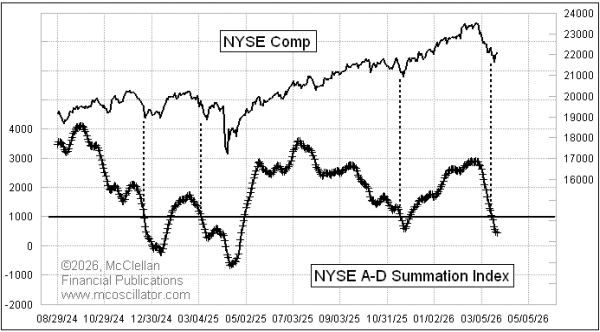
There is a fun magic trick which the McClellan Summation Index does when it crosses through its neutral level, which is the topic of this week's chart. The moment of crossing down through neutral tends to mark at least a temporary bottom for the price decline which brought about that crossing. This also happens crossing back up through zero to mark tops, but to a lesser extent.
The Summation Index chart shown above is the "classic" version, first created by my parents Sherman and Marian McClellan back in 1969. It is different from the Ratio-Adjusted Summation Index (RASI) which we use for some other applications in that first, it does not adjust for the changing numbers of issues traded like the RASI does.
The classic version is also different in that its neutral level is at +1000, and there is a brief story about this. When my parents first introduced the McClellan Oscillator and McClellan Summation Index to the world, there were no computers outside of large universities and the Pentagon. So anyone wanting to use these tools had to do all of the math by hand. The Summation Index changes each day by the value of the McClellan Oscillator, and some users would get confused about having to "add" a negative Oscillator reading to a negative Summation Index value. So to help avoid this computational confusion, they artificially boosted the neutral level to +1000. At that time in the early 1970s, the Summation Index had a total amplitude from highs to lows of only about 2000 points, so boosting the neutral level to +1000 meant that it would be very rare (and thus special) to see a negative Summation Index reading.
We thankfully have computers now to do our calculations for us, and the computers are not bothered nor confused by arithmetic operations. But we have kept the +1000 neutral level for the classic version of the Summation Index out of custom, and also to prevent confusion for anyone who has been using it for years. In reality, we could have the neutral level be any number we want and it would not make any difference. But the principle of there being a neutral level is important for this week's lesson.
Crossing down through zero offers us this fun magic trick of marking a bottom for prices. It may not be a permanent bottom, but it is a noticeable one. This is not new; it has been working this way for decades, and it is just one of the special features of the Summation Index, and also of the McClellan Price Oscillator for price-based indices. In fact, the Summation Index is mathematically like a Price Oscillator for the daily A-D Line. The Price Oscillator is calculated as the difference between a 10% Trend and a 5% Trend of closing prices. The Summation Index is calculated by summing McClellan Oscillator values, but it also can be arrived at by finding the difference between a 10% Trend and 5% Trend of daily A-D Line values.
This magic trick of marking price bottoms when crossing down through neutral is similar to the topic of a "rainbow convergence" of moving averages that I have written about before. See the prior article linked below. I cannot explain why this magic trick works, but it is a phenomenon with enough history to demonstrate that it does work even if one cannot explain it.
Tom McClellan
Editor, The McClellan Market Report
Nov 15, 2012
Summation Index’s Magic Tricks |
Feb 07, 2019
Rainbow Convergence: Some Charting Magic |
Sep 08, 2022
A Rainbow Convergence and a Head and Shoulders |